Robert Capa

"If your pictures aren't good
enough, you aren't close enough."

SPAIN 1936: DEATH OF A LOYAL
MILITIAMAN
Robert Capa
(still in question)
Source: Kelly, Christopher.
"Commander Kelly." : Robert Capa. Blogspot,
28 Jan. 2014. Web. 24 June 2014.

SPAIN 1937: RUNNING FOR SHELTER
DURING AIR RAID
Robert Capa
Source: "Robert
Capa." Magnum Photos. Magnum Photos, n.d. Web. 25 June 2014.

BARCELONA, SPAIN 1936: RUNNING FROM
AIR RAID
Robert Capa
Source: "Robert
Capa." Magnum Photos.
Magnum Photos, n.d. Web. 25 June 2014.

ITALY 1943: SICILIAN PEASANT
TELLING AMERICAN OFFICER WHICH WAY THE GERMANS HAD GONE
Robert Capa
Source: "Robert
Capa." Magnum Photos.
Magnum Photos, n.d. Web. 25 June 2014.

SICILY, ITALY: ON THE ROUTE TO
MESSINA
Robert Capa
Source:
"Robert Capa." Magnum Photos. Magnum Photos, n.d.
Web. 25 June 2014
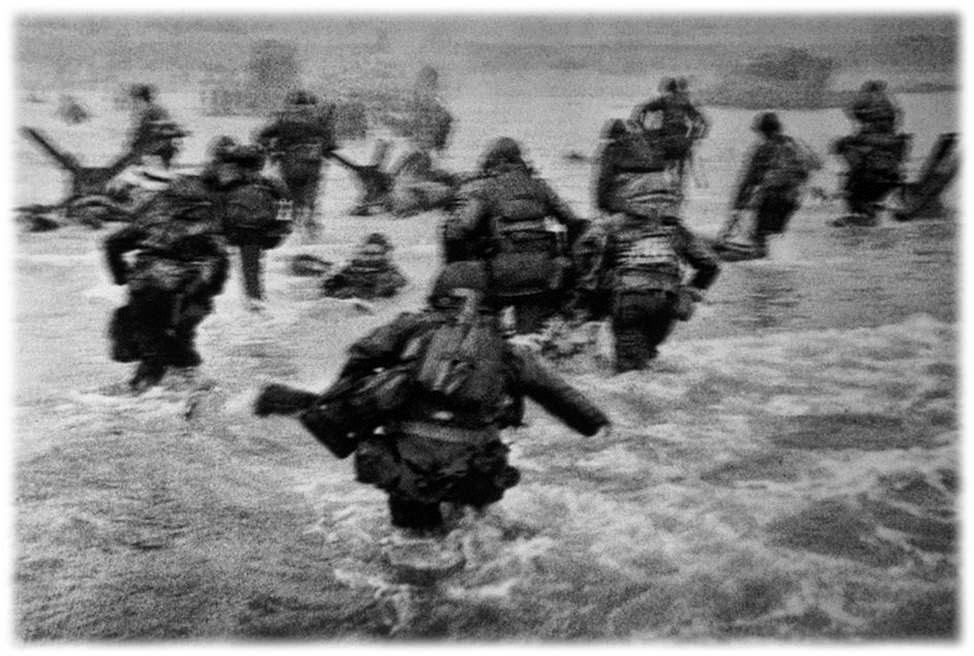
FRANCE 1944: NORMANDY INVASION
Robert Capa
Source: "Robert
Capa." Magnum Photos. Magnum Photos, n.d. Web. 25 June 2014.

FRANCE 1944: NORMANDY INVASION
Robert Capa
Source: "Robert Capa." Magnum
Photos. Magnum Photos, n.d. Web. 25 June 2014.

FRANCE 1944: NORMANDY INVASION
Robert Capa
Source: "Robert Capa." Magnum Photos. Magnum Photos, n.d. Web. 25 June 2014.

FRANCE 1944: NORMANDY INVASION
Robert Capa
Source: "Robert Capa." Magnum Photos. Magnum Photos, n.d. Web. 25 June 2014.

GERMANY 1945: GERMANS FARMERS FLEEING
THEIR BURNING HOUSES
Robert Capa
Source: "Robert Capa." Magnum Photos. Magnum
Photos, n.d.
Web. 25 June 2014

CHINA 1938: SINO-JAPANESE WAR
Robert Capa
Source: "Robert
Capa." Magnum Photos. Magnum Photos, n.d. Web. 25 June 2014.

USA 1946: INGRID BERGMAN & ALFRED
HITCHCOCK
Robert Capa
Source: "Robert Capa." Magnum Photos. Magnum
Photos, n.d.
Web. 25 June 2014

LONDON, GREAT BRITAIN 1944: ERNEST
HEMINGWAY IN A HOSPITAL BED
Robert Capa
Source: "Robert
Capa." Magnum Photos. Magnum Photos, n.d. Web. 25 June 2014.
Robert Capa was a Hungarian war photo journalist who aspired
to be a writer when he was a child. He was originally born in Germany under the
name of Endre Friedmann, but later assumed the alias Frank Capa to conceal his
Jewish identity from the rise of Nazism in Europe. Capa found it easier to sell
photos under this new identity, and thought that it made for a recognizable
guise in America. By 1933, Capa moved out of Germany to France to find work.
Capa’s first notable war photography was capturing the Spanish Civil War from
1936 to 1939 with his lover and photographer companion, Gerda Taro. In 1936,
Capa captured the most iconic, and perhaps controversial photo of the Spanish
Civil War, known as, “The Falling Soldier”. This image is believed to be of a
Worker’s Party of Marxist Unification falling to his death after being shot on
the battle site of Cerro Muriano. Debates and investigations surround the
image’s authenticity as many feel that the photograph was either staged or
taken by Gerda Taro instead of Capa. Nonetheless, “The Falling Soldier” is
considered one of the most famous war photographs taken of all time.
Robert Capa is most famous for his photography work during
World War II which he did for LIFE magazine.
Capa was considered the only “enemy alien” photographer for the Allies, due to
his European origins. He began his war photojournalism by taking photographs of
the American troops occupying the heavily German – defended Italy. Some of his
most famous photos from this time period include the capturing of Italian’s
happiness when American soldiers arrive as well as an Italian peasant pointing
to the direction in which German troops fled. Finally in 1943, Robert Capa was
able to capture the Naples Post Office bombing which was a result of German
planted bombings six days prior to the explosion.
Robert Capa’s most iconic work comes from his time spent
capturing the crucial and defining moments of WWII known as “D-Day”. Capa was
one of four photographers chosen to shoot the United States first few days of
storming Europe. He was admired for his
talent of being able to make himself completely invisible while on the
battlefield. Capa packed two Contax Camera’s, Rollei and Speed Graphic cameras
and telephoto lens in preparation in capturing the American soldiers invading
Europe. “D” was code name for invasion day, and on Tuesday June 6th,
1944 at 2:30 am, Capa boarded the U.S.S. naval ship Samuel Chase. Capa went with the first wave of invaders to storm
Omaha beach in which he explained in his memoir,” It was still very early and
very gray for good pictures, but the little men dodging under the surrealistic
designs . . . very effective”. Capa was able to make it to the beach where he
then was able to snap an estimated total of 106 frames. Capa remained on the
battiefield for approximately 90 minutes capturing moments of American soldiers
fighting and screaming for their lives in the ocean. He eventually found his
way to back to a transport ship.
Out of the 106 photos presumed taken, only 11 images from
the storming of Omaha survived. Capa’s film was giving to a lab assistant named
Dennis Banks to be processed. In a frantic panic and rush to process the
images, Banks put the film into a drying cabinet on high heat in hopes of it
speeding up the process. Instead, the heat melted all of the emulsion off the
film with only 11 images surviving. These images were of the “Big Red One” army
unit trying to maneuver themselves from the minefields. These famous images and
primary only known surviving images of D-Day were published in LIFE magazine. In 1954, Capa died doing
what he loved; he stepped on a landmine while trying to capture the advancement
of the French in the First Indochina War. Capa is known for revolutionizing war
photos as he got as close as he could to the action, whereas most war photos
were taken at farther perspective. He also coined the term “Generation X” by
using it as a title for a photo-essay about the youth reaching adulthood after
WWII.
Bibliography
Brenner, Marie. "Robert Capa’s Longest Day."
Vanity Fair. Vanity Fair, June 2014. Web. 24 June 2014.
Kelly, Christopher. "Commander Kelly." : Robert
Capa. Blogspot, 28 Jan. 2014. Web. 24 June 2014.
"Robert Capa." Magnum Photos. Magnum Photos,
n.d. Web. 25 June 2014.
"Robert Capa." Wikipedia. Wikimedia Foundation, 23
June 2014. Web. 24 June 2014.
